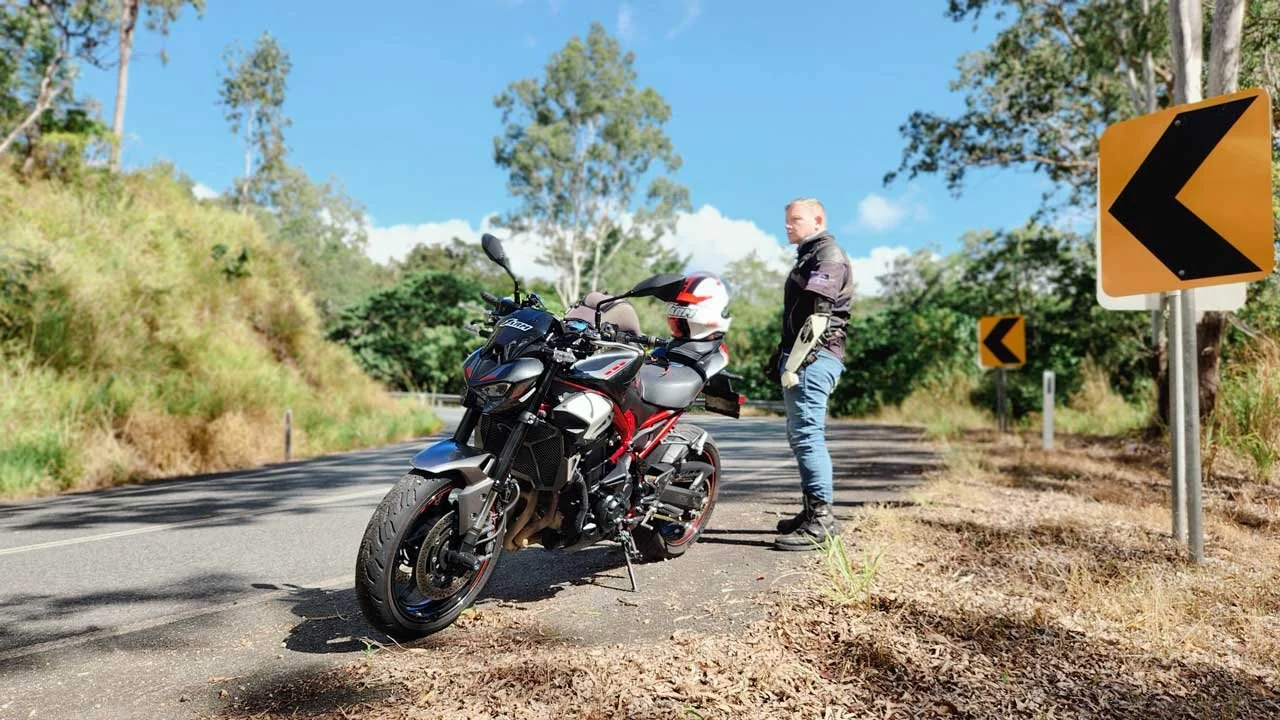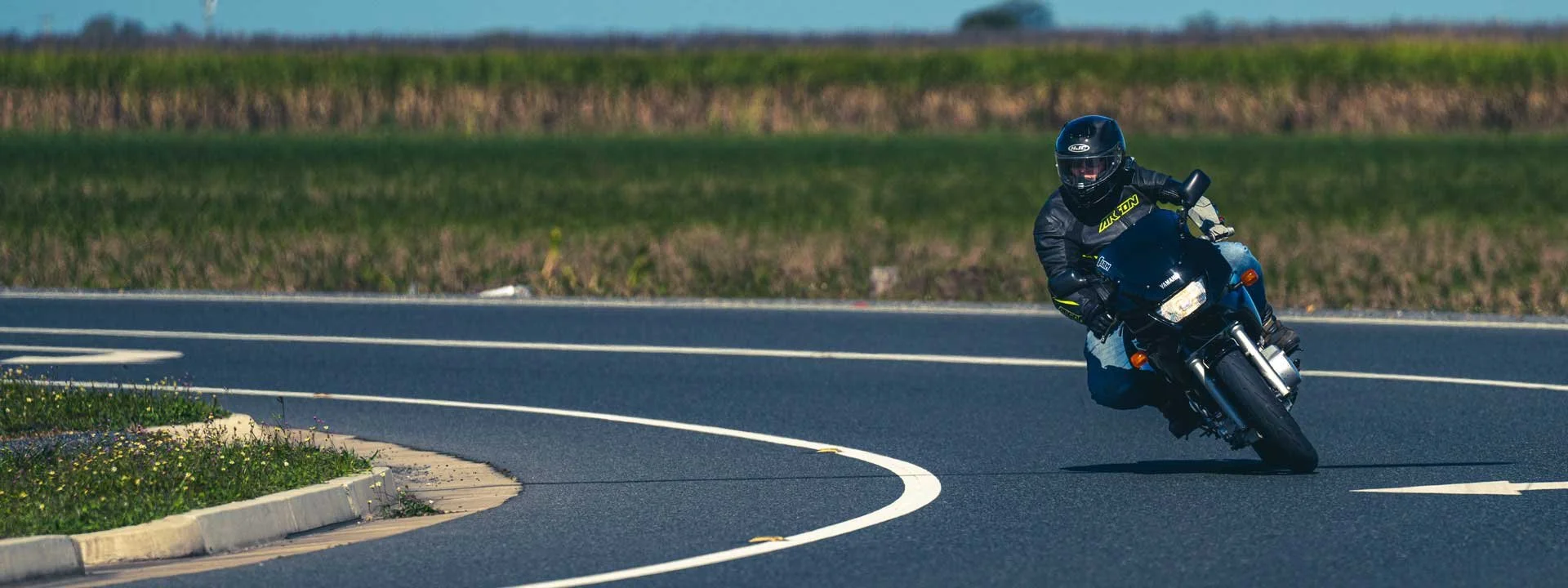
Going to my happy place

Everyone has a place they like to take their bike for a ride, a ride where they can go a little quicker than usual or just have fun.  A good road somewhere full of curves and turns, or maybe it's just a big straight line.  It's different for everyone, and that's cool.  I take my bikes to Koumala range.  It's tight with lots of turns, a nice road surface, and it's not fast, no long straights, it's all about getting the bike to turn.  That's the sort of riding I enjoy.  You could, if you wanted to, ride this place fast, but it's a long way from help, and sometimes riding fast can end in you needing help.

My golden rule, above all else, is I do this ride ALONE.  Strictly alone.

I’ve found that riding with others tends to trick you into riding at their limits, not your own.  I’m getting better at avoiding this trick; I’m usually very good at not trying to keep up.  I ride this place alone because I don’t want anybody trying to keep up with me.  Not because I’m some kind of professional, but because there are some riders who try extra hard when they see a one-armed rider doing what they do with two - especially if I’m doing it better than them.  If you find yourself in a group of riders pushing their limits and feel unsafe, just pull over and offer to take photos.  It's tempting, I get it, to push yourself, and I don’t want to stop you; I just want to give you an “out” if you need one.

If you have that “place” where you ride, to maybe slowly push a limit, or get a good buzz, try going there alone and just enjoying the ride yourself with as few influences as you can. You might enjoy it more.

Getting wet without the tech.

If it's raining, I purposefully take my old TRX 850 to Koumala range.  The wetter the better on that old tank.  For those who dont know, the TRX has no ABS or traction control.  No tech.  Just you and the meat between your ears to keep the bike on the road.  This is not for everyone, and that's fine.  My TRX has GOOD tyres, and I give the bike a more thorough-than-usual pre-ride check, ensuring tyre pressures, brakes, and suspension are all 100% ready.  Every bike is different. Heck, every bike of the exact same make and model can be different - different enough to make a big difference in a situation where a little difference puts an end to a fun ride.  TLDR; set YOUR bike up so it's right for you and how and where you ride.

The first few runs, in the wet on the Rex (TRX), are still tense, you’re fighting all those fears of riding in the wet - accelerating slowly, tentatively, and braking oh so gently into turns, afraid you’ll lose the front.  But the more time I spent on the bike in those conditions, the more my confidence built. You start to relax, the power comes on earlier and earlier, the braking becomes harder and harder, and the braking distances start to shrink and shrink.  Before you know it, it's like the water isn't even there.

Conversely, eventually your confidence curve and the performance curves of the tyres intersect, and you’re given a gentle reminder it's time to go home when the rear drifts a little too wide, or the front starts to fold under brakes.  But, by then, your pants are starting to soak through, and you’re keen to get dry anyway.

It all sounds spooky or reckless, but I see it as controlled exposure therapy.  And, if I could choose the message here, it would be preparation, preparation for riding in adverse conditions isn't optional.  Check your bike, maintain those skills, and keep your confidence levels honest and accurate.

Neutral runs - no brakes, one arm

This is just for me here.  Dont try this at home.  Once I’ve gotten settled and have ridden the range a few times, I do what I call a “neutral run” - at the top of the range, I build enough speed, then put the bike into neutral and roll all the way down.... but, I do it without using the brakes.  Sounds terrifying, doesn't it? But, in reality, it isn't, as the speeds on the way down (just rolling) at their peak are quite slow.

For me, this is about building confidence in how well I steer the bike and how well the bike lets me steer.  There are no other influences; just you, the bike and gravity.  That whole “looking where you want to go” thing becomes a little easier to dial in; your body position and how you move on the bike soon become more fluid and natural.  Above all, you learn to trust the bike.

Once I’ve done a few good, clean, smooth neutral runs, I’ll do more than a few using just one arm - my prosthetic arm alone.  This is to improve the connection and feedback between me and the arm, build strength in the little muscle I do have, and dial in the arm's settings.  The neutral runs down, using only the prosthetic forces, has me USE the arm to load it up and get comfortable with the forces and feedback involved in steering the bike. That fancy Float shock in the arm has knobs and dials to fiddle with, and these runs really help to get those settlings right.

Why these rides matter to me

Koumala Range is where I go to:

  • refine my skills

  • maintain my confidence

  • maintain my physical capability

  • test and tune my prosthetic arm

  • push myself without ego

  • ride without comparison

  • learn without pressure

  • To blow off some steam (leak a little bit of stupid) because I am still very human

It’s where I go to stay sharp.  To stay honest.  To stay connected to the rider I’ve become, not the rider I used to be.

Every run up and down that range is a reminder that riding isn’t just about speed or skill.
It’s about self‑awareness, discipline, and deliberate practice.

And for me, it’s about proving — quietly and privately — that I can still do this.
Not for anyone else.  Just for me.

Learning to Ride: Three Chapters on Two Wheels

Looking back at how I learned to ride, it feels like I’ve lived through three separate chapters. Each version of myself thought he had it all figured out, only to be proven wrong. It’s funny now, but it’s also why I care so much about rider education and don’t believe the usual stories about learning on dirt bikes or racing motocross.

I’ve been through all of it, and I’ve faced the results of thinking that was enough.

Hill Billy riding school

My first riding lessons were just what you’d expect for a kid around bikes: mostly unsupervised, sometimes watched over, but always with care. My dad tried his best, and after a few years tearing around the farm on my old chook chaser, I could ride a motorcycle. But farm riding only teaches the basics like throttle control, balance, and how to crash without admitting it hurts. It doesn’t teach you how to handle traffic or understand risks.

It definitely made me confident, but it also gave me a false sense of skill. That combination can be risky.

I cringe a bit when I hear riders repeat clichés about learning off-road or racing dirt bikes. I’m not saying that experience doesn’t matter—I get wanting to share your riding background—but often it’s outdated, limited, and only partly useful for riding safely and enjoying motorcycles on the road.

To be fair, I was that guy once, too. No judgment.

The Old Licensing System

Back in 1993, getting a motorcycle license in Queensland was simple. There were no requirements beforehand—just a short written test, some basic moves in a car park, and a quick supervised road ride. No one gave detailed feedback; you just had to avoid making big mistakes. There was no focus on hazard perception or how to handle risks on the road.

I was happy with that at the time - didn't care, got my license.

Now I wonder how many other riders got their license the same way, without learning solid skills or how to be safe on the road. Sure, they’re still riding and probably still have both arms, but are they the ones who think every car driver is out to get them? That negative attitude is something we’ve all seen in riding culture.

The Accident and starting again

Fortunately, my brain adapted very quickly to riding one-armed.  It's easy when you don’t have a choice.  So, re-learning was more about putting my new attitude toward riding into play.  That and learning how to operate the bike with only so many fingers; clutch, brake and controls. There were constraints: there was no more farm to ride dirt bikes on, so I had to develop the skills I could in the cul-de-sac out front of my dad's house.  Fortunately, that meant all slow-speed practice and getting comfortable going slow. Fortunately, because at that stage I was still testing with an arm cobbled together from an old broom handle and 3D-printed plastic parts. In the three months of “testing” and all this slow riding, I don’t think I ever went over 40 km/h.  Most riders avoid this stuff, riding slow, but I feel it's the best foundation for riding.  You’ve got to be more in touch with the bike and its controls, and it exposes small weaknesses early before they become big problems once you’re at speed.  If you’re new to learning, it can be humbling at first, but it builds confidence quickly with minimal risk.

The Occupational Therapist, Qride and the great unlearning

This was after my big accident, so it won’t apply to everyone, but before I could move on to motorcycle testing, I had to pass a motorcycle test. This was an OT assessment to check if I could ride safely. They did a medical and physical exam to see if my body could handle it, and a perception test to make sure my mind was ready, all before I could show my riding skills. I was grateful for all the practice I’d put in before this assessment.

Q-ride was 10/10 though.  People who have issues with Q-ride need to think more about other riders more than themselves.  That, and maybe admit that they DID come out of Q-ride just a little bit better than when they walked in.  The benefits of programs like Qride, even to those sceptical of these programs, are that there are MORE riders on the road, and they're safer because of it.  I’m happy to ride the way I ride, and I’m happy to see a rider fresh into it riding safely and within their own limits, enjoying the benefits/outcomes of whatever training they’ve completed.

While going through the Qride system in Queensland, I got rid of a lot of bad habits I had before my accident. Some habits you don’t notice until they cause problems, and sometimes learning a small new skill can make riding much easier or more comfortable.

Unlearning/relearning is much easier when your mind is open to it.  Losing the arm wasn’t the key to opening my mind to training programs like Qride, and while most of my openness to learning came from the research into my arm design, the bulk of it came from the simple enjoyment of riding.  A few seemingly simple skills and the abandonment of some bad habits took a lot of the noise out of the already busy experience of riding a motorcycle.  I get to enjoy the time on the bike a little more.

Like father, like Son?

I was deep into relearning when my son decided to start riding motorcycles. I wasn’t fully licensed yet and was still working on my arm design. I have to admit, I panicked.

Maybe it’s just a dad thing, but my first thought was, “You can’t just decide to ride motorcycles.” I used to think riding should be part of your life before you hit the road with others. That old mindset came back, and suddenly I believed you really did need that ‘I learned to ride on a farm’ experience to be a good rider.

I didn’t hold him back. Instead, I supported him and helped him prepare for his test, even as I was still learning myself. Once he got his license, just a few months after I did, I kept encouraging him to ride with me. Skills matter, but you have to keep practising and building on them. My son will find his own style, but keeping those skills sharp is key to his confidence, passion, and most importantly, his safety.

We’re all still learning.

Every rider learns in their own way, and that’s fine. Roads and risks are always changing, so I’ve found that staying curious and practising often helps me ride with more awareness and confidence. It also makes the ride more enjoyable.


If you’re happy with your progress, that’s up to you. I hope you’ll support others who want to improve at their own pace. Share what you know, learn what’s helpful, and let’s all help each other stay safe.

My first "not a real accident"

Here’s how a dog, gravel, and a cigarette-break lecture put the first small dent in my riding behaviour.  This experience didn't have an immediate effect on how I rode, but I did get my first lesson in “getting back up” after a fall.

First up, let's understand the metric by which I registered motorcycle accidents back then - if I didn't spend the night in the hospital, it's technically NOT an accident. This was my first "not an accident but technically an accident" after getting my license. I no longer use this metric; I’ve had my fill of time in the hospital.

I was riding my bike to school, racing a mate, when I hit a dog.  I remember the dog doing much the same thing as the dog from my 4500km road trip - it was crossing the road, saw me, ran in its original direction before turning and running back across the road.  The sequence in my brain went "oh no, a dog, better slow down" to "it's off the road now, back on the gas" to "ahh fuck" and me colliding with the dog.  I didn't make any directional changes, and I only briefly closed the throttle before accelerating again; no brakes were applied. No caution.  A simple accident to avoid, really, as I had the skills.

And, man, did I get minced up.  I slid down the road, under the bike, for a fair distance. Grinding off layers of skin as I had no protective gear - just shorts, a shirt, sneakers, and a helmet.  I even got some burns from the bike's exhaust to top it all off.  [Insert lecture about wearing proper gear HERE]

Once I stopped sliding and grinding, I got up to assess how bad the situation was - to take in all the pain, and appreciate just how badly I was bleeding.  Fortunately, I crashed outside the homes of some really lovely old ladies.  Unfortunately, they all came running out with hydrogen peroxide and all manner of disinfectants, which they quickly doused my wounds with.  Pain-o-meter went to 11.  But I was pretty grateful for all the care and attention I received at the scene.

Then my Dad turned up.  He didn't call an ambulance or bring first aid.  He brought with him a long and fiery, curse-word-filled lecture about my terrible riding.  I need you to understand that the "lecture" did not stop as he bundled me into his car and took off.  To the hospital?  To an ambulance?  No.  To the corner shop, where he purchased a drink, a packet of cigarettes, a newspaper, and something to eat.  I'm still bleeding this whole time, and I must have smelled like a freshly sanitized science lab from all the chemicals I had been washed down with.  The lecture had not stopped, only brief pauses as he ate and drank, and puffed on a cigarette.  No drink for me. Nothing to eat.  I didn't smoke then, but if smoking clotted my blood a little, I'd have given it a crack.

Even after his impromptu breakfast, the lecture continued.  What was he saying?  I don't know, I was bleeding and fixated on where we were going next when we drove off from the corner shop.  We owned a small farm at this point in life, and I genuinely thought we were off to do a day's work there despite my wounds.

You're all thinking my Dad was a bit hard on me, but he pulled through eventually and took me to the local ambulance station.  The lecture did not stop the entire ride, any more than my bleeding.  When we get to the ambulance station, I'm wheeled into a room for a brief respite from the lecture to have my gravel rash cleaned out.  Pain-o-meter goes to 15!  Maybe they give pain relief nowadays, or maybe my Dad paid extra so they wouldn't, but I do NOT recommend high doses of gravel rash even when you're drunk on hydrogen peroxide and floating down from significant blood loss.

With my wounds freshly brushed and deburred, debrided and bandaged, I was handed back to my Dad.  And the lecture continued, with renewed gusto as he had time to catch his breath.  Normal parents probably let you have a day or two off school with such extensive injuries, or if you couldn't use your hands because they're both fully bandaged.  Not my Dad - he took me straight back to school so I could get some learning in before the day ran out.  I think it was because he'd run out of lecture points.  Either way, I went to school and walked home that day, bandaged, beaten, and bleeding.  The next day, after the bike was beaten back into shape, I rode to school wearing every bit of safety gear I owned.  Gravel rash sucks, do not recommend.
And, my Dad isn't the villain here. He just administered a tough lesson, and I appreciate how tough it was to give.  Tough love.  Accept responsibility for, and the consequences of, your actions.  I mean, it didn’t stop me from doing stupid stuff, but I did learn not stay down when I fall, and I learned that regardless of the work required to get back up, I would.  And that applies to life off the bike also.

PS - the school put up a fight - I had all my arms back then and they were both fully bandaged, as were my legs. I imagine I may have been still in shock also, and getting my two brain cells to swim in a brain low on blood was a challenge.  They asked why I was late. I said, "I was in a bike accident, look at me," and they responded, "We're going to need a note."  I had to sign in, but couldn't use a pen (bandaged hands), so I think they told me not to worry about the note.

Wisdom Is Earned, Not Given

I’m trying to remember a quote I heard recently, but it's gone.  Wisdom is earned, not given - is the best my memory could click with after a Google search.  Essentially, we all know, you can offer someone advice, warnings, crash stories, statistics — but if they’re not ready to hear it, it won’t land. I know that because the rider I used to be wouldn’t have listened either. Not out of disrespect. I just thought I already knew enough. I thought I was skilled enough. I thought consequences were for other people.

And that’s the thing — a lot of riders react badly when someone suggests slowing down or riding more safely. You see it in the comments online: the jokes, the bravado, the dismissals. It’s a defence mechanism. It’s easier to laugh than to look at your own behaviour. It’s easier to protect the identity you’ve built around riding than to admit you might be taking risks you don’t need to take.

I’m not under any illusion that sharing my story will change every rider. I know it won’t. Some riders will read what I write and shrug. Some will roll their eyes. Some will think it doesn’t apply to them. And that’s fine. I get it. I used to be wired the same way.

What I am hoping for is something a bit different.

If my perspective doesn’t reach you, that’s okay — just don’t stand in the way of the riders it does reach. Let them take what they need from it. Let them grow at their own pace. The same way we tell new riders to “ride their own ride,” I think we also need to let riders change their own ride. If someone wants to slow down, ride smoother, or rethink their approach, let them. Don’t drag them back into the mindset you’re in. Don’t mock them for choosing a safer line.  And, dont leave them behind.

Not every rider wants to be the hot‑headed, warp‑speed version of themselves forever. Some of us grow out of it. Some of us don’t. That’s just how it goes.

And if you’ve been riding a long time, you’ve got more influence than you realise. You can lead by example. You can show that skill and safety aren’t opposites. You can show that enjoying the ride doesn’t require proving anything to anyone. You can help create space for new riders to find their own identity on the bike — not the one the loudest voices in the community push onto them.

Side track

One thing that grinds my gears is how often the slower or newer rider gets left behind. A group will take off at the pace of the fastest rider, and the person still finding their feet ends up riding alone or, worse, pushed to ride outside their limits just to keep up. That’s not leadership or cool.  If you’re the hotshot in the group, you need to appreciate the responsibility you have - there are other riders watching you, possibly trying to emulate your behaviour with less skills and less experience.  That, or the rider you left behind rides less, gives up on bikes.  Even worse, they DO try to keep up, and they could end up being an entirely different kind of problem for you.  If we can’t look after the ones coming up behind us, what are we even doing?

Insert my usual disclaimer - I’m not trying to preach. I’m not trying to tell anyone how to ride. I’m just sharing what I’ve learned, knowing full well it won’t land with everyone. But if it helps even a few riders shape their own path — or gives them permission to ride a little more chill — then it’s worth writing.

"Criticism of riding behaviour" ≠ "Criticism of riding ability" (mostly)

It's best to focus on myself - my experience right up until my arm accident.  And, I’ll be honest, I should include my experience in the first two years after getting back on the bike.  This is me doing my best to address a bad habit all riders have: confusing criticism of our riding behaviour with criticism of our riding ability.

I've certainly had somebody say "you ride like a dickhead", heck, I've definitely had a police officer tell me much worse.  Did it sink in?  Obviously no.  Why not? Because whoever said things like that to me was attacking my ability to ride - that's how I saw it.  I didn't hear the message - you're taking unnecessary risks, you're on borrowed time if you continue riding like that.  I heard what they didn’t say: "You have zero skill, you can't ride a motorbike."  Which wasn't true - I could ride a motorcycle pretty well, I mean, I had a pretty awesome scoreboard; 4 police pursuits without capture, incredible "lap times" between two locations, heck, back in the day, I could even do wheelies.  Proper wheelies, that looked cool, I tell ya.  I had skills; I could ride, so anybody implying I couldn't ride or that I rode poorly fell immediately into the "ignore this person" bucket.

I’m always banging on about confusing the willingness to take unnecessary risks with “skill”.  But I think I’m going to start suggesting that some riders confuse the willingness to take unnecessary risks with a way to communicate their self-worth/status/skill to other road users/riders.  

I’m not preaching.  I'm still not a perfect rider, or an ideal human.  But awareness and acceptance are a start, and I've been chipping away at my riding behaviour.  A few things have helped me change the way I ride: realising you don't actually have to ride like a hooligan to enjoy the ride, and who am I actually trying to impress by riding without regard for risk? Am I really teaching the slow car driver a lesson by accelerating by them at warp speed?  Maybe the type of people I want in my life aren't the type who are excited by watching me run around in a hurry to hurt myself.  I’m not sure who you ride with, but I’m pretty sure they’d be sad if you didn’t make it home one day.

Lately, though, I’ve become acutely aware of how my riding behaviour affects public opinion of motorcyclists in general.  There’s a lot in that - if the community continues to see us as “temporary Australians”, what are the potential outcomes?  I can think of a few negative effects on the motorcycling community if we dont start tightening up our behaviour on the road, and I want none of them.  I love riding bikes, and I want to ride them for as long and as often as I can, unhindered by increasingly restrictive laws/costs.  But my big concern is that I want Karen, in her giant 4x4, to see me as a human, not some yutz who has no regard for his own life.  Maybe, just maybe, if the average driver starts thinking  - motorcyclists = humans too -  they might drive with more awareness.

These are the things I think about while I'm riding my bike.